Oct 11, 2026
Sparta, NC: Five Standing Seam Metal Roofs, Panels Made On Site

Quick answer: Repair a roof when it’s still pliable, was installed correctly, and the problem is truly fixable, like a pipe boot that can take a cover. Replace it when it was installed wrong (for example, racked shingles) or has aged to the point where a repair would damage the shingles. Age alone doesn’t decide it. After a storm, check from the ground for dented downspouts, shredded plants and hail marks on decks, windows and trim, then have a professional do the full assessment.
Never go up on your own roof. Leave that to a professional. Everything on this page is something you can check from the ground. A professional should always do the full assessment.
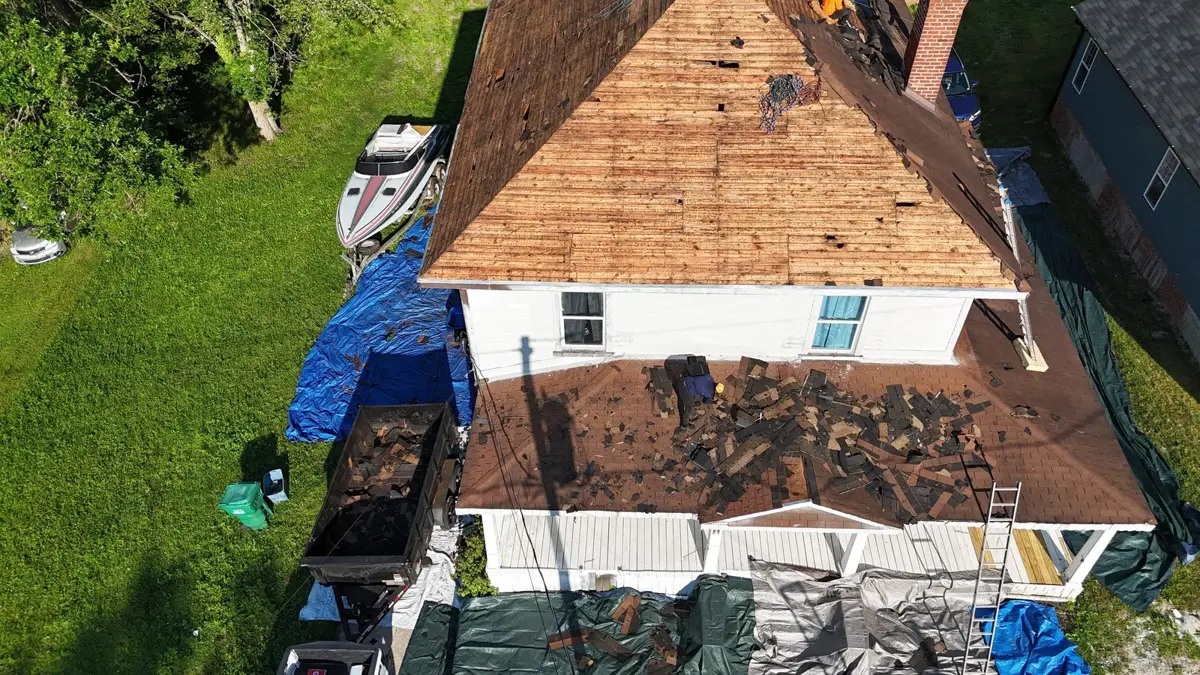
We start with an overall assessment. Age alone doesn’t decide it. We’ve seen 25-year-old roofs that look new and 3-year-old roofs that look 20.
On every assessment, we look for three things:
What we find tells us whether a repair makes sense or the roof needs to be replaced.
We recommend a repair when a repair is truly needed and possible. For example, a roof that is still pliable and was installed correctly, or a pipe boot that can be fixed with a cover instead of tearing into the shingles.
We replace when the roof was installed wrong, or when it has aged to the point where a repair would damage the shingles.
We never recommend repairing an improperly installed roof. It keeps leaking because it was installed wrong, and the homeowner ends up calling us back again and again.
| A repair usually makes sense when… | A replacement usually makes sense when… |
|---|---|
| The roof is still pliable and was installed correctly | The roof was installed wrong, for example racked shingles |
| The problem is truly fixable, like a pipe boot that can take a cover instead of tearing into shingles | The roof has aged to where a repair would damage the shingles |
| A repair will actually stop the leak | The leak keeps coming back because of how the roof was installed |
See our roof repair and roof replacement services, and the Triad roof replacement cost guide if you’re weighing a new roof.
Yes. A roof’s age doesn’t tell the whole story. We’ve seen 3-year-old roofs that look 20, and improper installation is one of the big reasons.
We’ve done well over 1,000 roofs each in High Point, Greensboro and Winston-Salem. The same three things come up again and again:
Shingles must be installed in the stair-step method, not the racking method. Manufacturers specifically say not to rack.
In our experience, racking creates vertical joint lines straight up and down the roof. Water runs straight down the roof, so it accumulates in those shingle joints. Small, repeated accumulation becomes a substantial leak.
For the full explanation, read our post: Racking vs. Stair-Step Shingle Installation: Why It Causes Leaks.
Stair-step is the installation method manufacturers call for. Here’s how we do it:
Each row is offset from the one below it, so the joints never line up straight up the roof.
Racking is hard to see on a new roof. As the shingles age, you can clearly see vertical lines from the ground if you know what to look for, and they get more pronounced with age.
You don’t need to get on the roof to spot signs of a hail storm. From the ground, look for collateral damage:
If you see these around your home, the roof may have been hit too. A professional should always do the full assessment.
Look for creased or missing shingles. Also watch for shingles that blew up and lay back down. When that happens, it breaks the factory sealant, so those shingles may never seal correctly again. That’s hard to judge from the ground, which is one more reason a professional should do the full assessment.
We start at the perimeter: gutters, window trim, downspouts, and wood decks after hail. We take the same set of photos every time, to keep it simple and consistent.
We usually check the attic to confirm whether the roof has solid sheathing or spaced boards, so we know in advance and can let you know.
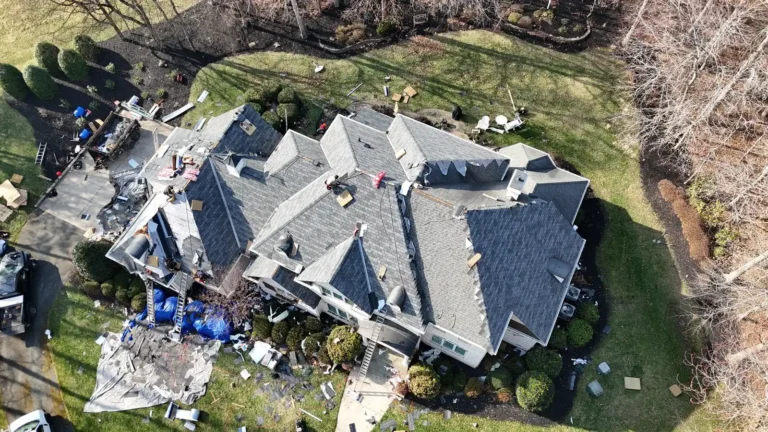
If the roof is walkable and accessible, we always do a thorough on-roof inspection. We also use a drone for overview photos, including a big overview of all slopes, sometimes after we chalk-mark the damage.
Inspections are free. There’s a charge only if you want a written inspection report and don’t hire us. If you hire us later, that fee is credited toward your repair or replacement.
We document damage with photos. If you file a claim with your insurance company, we can be there when your adjuster inspects, to point out the roof damage. You work with your own insurance company on your claim.
Call us. We’re open 24/7, and storms sometimes come out of nowhere, so our trucks always carry tarps. See emergency roof repair.
From a single repair to a full replacement, one team handles it:
We serve homeowners throughout the Triad, including High Point, Greensboro, Winston-Salem, Lexington, Kernersville, Jamestown, Thomasville and Clemmons.
Call the office nearest you, 24/7: High Point 336-936-5245, Winston-Salem 336-936-5692, Lexington 336-438-8705.
Seeing dents on your downspouts or shredded plants after a storm, or just not sure whether to repair or replace? Stay off the roof and call our High Point office at 336-936-5245 for a free inspection. We’re open 24/7.
No. Never go up on your own roof. Check from the ground and have a professional do the full assessment.
No. We’ve seen 25-year-old roofs that look new and 3-year-old roofs that look 20. We start with an overall assessment.
Premature deterioration, storm damage and improper installation.
When a repair is truly needed and possible, like a pliable, correctly installed roof or a pipe boot that can be fixed with a cover. We never recommend repairing an improperly installed roof, because it keeps leaking.
An installation method that manufacturers specifically say not to use. It creates vertical joint lines straight up and down the roof, where water accumulates until it becomes a substantial leak. Shingles should be installed in the stair-step method. Racking is hard to see on a new roof, but the vertical lines get more pronounced from the ground as the shingles age.
From the ground, look for dents on downspouts and other soft metals, shredded plants and bushes, and hail marks on wood decks, windows and trim.
Creased or missing shingles, and shingles that blew up and lay back down. That breaks the factory sealant, so they may never seal correctly again.
Yes. There’s a charge only if you want a written inspection report and don’t hire us. If you hire us later, that fee is credited toward your repair or replacement.
Yes. We document damage with photos and can be there when your adjuster inspects to point out the roof damage. You work with your own insurance company on your claim.
We never recommend repairing an improperly installed roof. It keeps leaking because it was installed wrong. When a roof was installed wrong, we recommend replacing it.
Stay off the roof and call us. We’re open 24/7, and our trucks always carry tarps.
Usually, yes. We check whether the roof has solid sheathing or spaced boards, so we know in advance and can let you know.
Yes. We use a drone for overview photos, including a big overview of all slopes.
For a 2,000 sq ft house, Basic typically runs $8,500 to $10,500, Standard $10,000 to $13,000, and Premium $12,000 to $16,000. Your exact price depends on your roof.
Yes. We make custom gutters in-house.